Alberte Goldschmid
The Hanging GirlAlberte Goldschmid was a young student at Bornholm Folk High School whose fatal collision on November 20, 1997, became the defining mystery of Christian Habersaat’s life and, years later, a case for Department Q. Remembered for her beauty, musical and artistic gifts, and conspicuous presence among her peers, she is gradually recovered through testimony, a postcard to her twin brother, and drawings that offer a more intimate record of her final days. The investigation’s central contrast is between the public image of a popular young woman and the unanswered private details surrounding where she was going when she died.
Identity and Background
During the winter half year, about fifty students aged eighteen and older attended Bornholm Folk High School, taking courses in music, glasswork, painting, or pottery. Alberte was among the youngest. A witness remembered her as younger than her own daughter and closer in age to the pupils she had seen leave tenth grade than to the older students. The account places Alberte in a largely cheerful, ordinary student community: on November 20, her classmates had no sense that anything was wrong.
The students’ image of her was unusually vivid. One witness described her as one of the prettiest girls at the school, but remembered more than her features: Alberte moved with a gliding step that recalled Greta Garbo, seemed almost princess-like, and drew notice even in a crowd. Another witness recalled that she was beautiful and full of life, and that boys and men often looked toward her. This attention could provoke jealousy among some of the younger women, although the witness did not consider it serious at the time.
Alberte’s presence was not limited to appearance. She was interested in music and had a sweet singing voice; she also took glasswork classes and made drawings considered talented by those who later examined them. These abilities recur in the investigation not as decorative details but as parts of the life interrupted by her death. Her parents, Mr. and Mrs. Goldschmid, lived in Hellerup. Her twin brother David was older by seven minutes, a small fact that gives their closeness a precise, affectionate measure even as the conversation about him turns to loss.
Freedom, Relationships, and the Final Days
A police superintendent characterized Alberte as an ordinary young woman who had encountered freedom away from her parents and was making use of it. His account suggested that, during the couple of weeks she was on Bornholm, she had several partners. The description is a witness’s interpretation of her conduct, not a complete account of what she wanted or felt. The case repeatedly tests such partial versions against the details left by Alberte herself and by the people around her.
A postcard to David records a visit to Østerlars Round Church. Alberte wrote about the church’s associations with the Knights Templar, but the most personal news was that she had met an attractive man who knew more about the building than the guide. She planned to meet him outside the school the following day and promised to tell David more later. The card has no legible date on its reverse. When Carl Mørck later checked the school trip with the rector, he established that it had taken place on November 7. The postcard therefore places Alberte’s first recorded meeting with the man less than two weeks before her death.
A former student’s recollection adds a different trace of that encounter. On the church trip, the group had met a man who boasted that he could bend spoons and called himself Uri Geller the Second. The witness thought this was the man Alberte dated. Another former student had taken photographs during the trip and recalled capturing him by the church, though the pictures’ whereabouts were uncertain. The testimony does not settle the relationship, but it gives the investigation a specific public setting and a possible image to seek.
Alberte’s last days also appear in the account of Synne Veland. The day before Alberte disappeared, students from a visiting folk high school had come to the school; despite her interest in music, Alberte was absent at the end of the afternoon and did not attend the party that evening. Synne remembered that Kristoffer Studsgaard, a boy Alberte had flirted with, said she had found someone outside the school. Alberte had seemed distant over the preceding days and had missed most glasswork lessons during her final week. The combination of absence, new attachment, and interrupted routine became suggestive only in retrospect.
The Collision and the Case
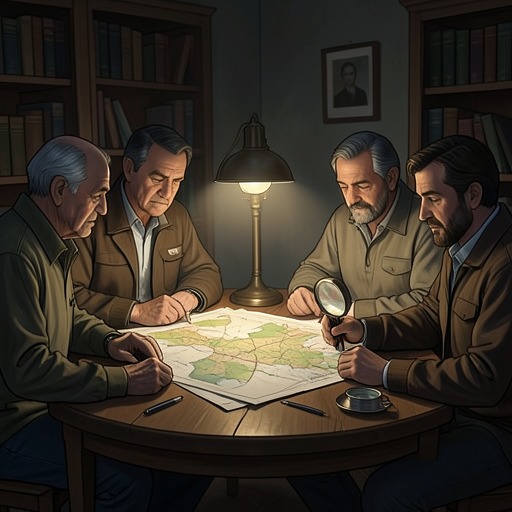
Alberte had cycled out early on the morning she was killed, taking a side road some distance from the school. Her destination was unknown. Carl considered whether she might have been going to meet the man she was infatuated with, or to a place where the two exchanged messages, but treated this as a possibility rather than established fact. A caretaker had said that Alberte often cycled and loved the surrounding countryside, and that she was usually away for about half an hour. Using that estimate and a cycling speed of about twenty kilometers per hour, Carl calculated that a stop within roughly five kilometers of the school could fit her routine. The tree where she was found lay inside the circle he drew on the map. The calculation narrows a search; it does not prove that the tree or nearby road was a meeting place.
On November 20, the students knew only that the day had begun normally. Alberte had been killed in a car accident that morning, but her body was not found until a little more than a day later. She had been thrown high into a roadside tree, where a passing uniformed police officer from Nexø, Christian Habersaat, looked up and saw her. The sight of her limp body remained fixed in his memory. With few leads, the death was treated as the result of a serious hit-and-run, unusual in Bornholm’s recent history.
The early search produced no skid marks and no paint flakes from a vehicle on Alberte’s clothes. Residents along the road could identify no likely driver; one person had heard a car moving at terrible speed in the direction of the main road. The police then searched for cars with unexplained damage to the front. Ferry departures to Sweden and Copenhagen were monitored throughout the week, and all twenty thousand vehicles on the island were called in for inspection at motor-vehicle diagnostics in Rønne and Nexø. The scale of the search underlines how little the evidence initially offered: a damaged girl in a tree, a speeding car heard but not seen, and no trace that pointed to a particular vehicle.
The autopsy made the circumstances of Alberte’s death more painful and more precise. She had fractures and internal bleeding, but no single injury was judged fatal on its own. Both shinbones and calf bones were broken, along with other fractures. The evidence indicated that she was alive when she was flung into the tree and remained alive for a considerable time afterward. Hanging head down, she lost blood; the injuries were not immediately fatal, but the blood loss was enough. The image that had first reached Habersaat as a terrible roadside discovery became, for Carl and his colleagues, a reconstruction of prolonged suffering.
What the Investigation Recovers
Habersaat’s private archive shows how completely the unsolved case occupied him. His chaotic-looking home contained an organized collection representing almost two decades of research into Alberte’s death. The living room served as a sorting point for incoming material; chronological paper piles and shelf registers directed investigators through the house’s different subjects. The dining room gathered leads that could not be dismissed, while other rooms held local interviews, parallel police inquiries, hit-and-run files, and statements about Alberte’s background. Habersaat had even retained material about friends from before her time at Bornholm Folk High School. His archive preserves not only the case but the effort to keep Alberte’s identity from narrowing into a single unexplained death.
The investigation also exposes the dangers of reading the past through suspicion. When questioning Inge Dalby, Carl put forward a theory that she had been jealous of Alberte and had caused the collision. Inge admitted that she had harassed Alberte: she described damaging her clothes in the wash, encouraging her to go without warm clothing, and salting her food. She also said she could hear Alberte speaking to herself in the next room and described her imagining the man’s presence. But Inge denied killing her. The exchange establishes cruelty and rivalry in the school’s social world; it does not make Carl’s accusation a proven account of the crime.
Alberte’s art eventually brings the investigation closer to the man she had drawn into her life. After the planned school exhibition was cancelled because of her death, the school secretary sent the drawings to her parents in Hellerup, despite the police having requested them. Rose went to collect the work and returned with four sketches, numbered twenty-three through twenty-six on the exhibition list. Among the titles were Rocks on the East Coast, Sunshine on Gudhjem, and Mist in Almindingen. The final drawing, Future, showed a nude Alberte in front of a mirror, with a man’s face behind her. Unlike the earlier image of Alberte alone, this one gave the investigation its most detailed view yet of Frank Brennan. The drawing does not explain what Alberte knew or what she expected from the future; it makes the absent man visible in a work that survived her.
Memory and Narrative Role
Alberte is encountered after her death, through records, remembered gestures, and other people’s interpretations. The initial accounts call her popular, beautiful, and full of life; the postcard makes her excitement about a new meeting more particular, while the missed lessons and absent party show how her ordinary schedule had begun to change. Neither kind of evidence fully explains her. Their differences matter: a public reputation can make a person seem legible even when the crucial facts remain unknown.
The recurring tree and the face in Future give the investigation two sharply different images of Alberte. In the first, she is a body found too late, suspended above the roadside and fixed in Habersaat’s memory. In the second, she is an artist who has placed herself before a mirror and drawn another person into the scene. As Carl, Assad, and Rose pursue the case, those images resist collapsing into one another. The investigation’s work is to recover the relationships and choices hidden behind the fatal morning, while recognizing that surviving testimony and artwork can disclose clues without restoring every part of the life they record.